Open any panchang or almanac app and you will meet a quiet assumption: that the sky changes at midnight. Days are labelled auspicious or inauspicious as whole calendar squares, as if the cosmos checked the wall clock before moving. The classical texts never made that assumption — and the difference is not academic. It can move a verdict by hours, sometimes by a whole day.
What the classics actually demand
The Chinese almanac tradition — the 通勝 (Tung Shing) your grandmother's generation consulted before fixing a wedding date — rests on three moving parts, and every one of them is astronomical, not calendrical.
The solar terms (節氣). The year is divided into twenty-four stations, each defined as the instant the Sun reaches a multiple of 15° of celestial longitude. Not a date — an instant. In 2026 the Summer Solstice (夏至) arrives on June 21 at exactly 16:20 Beijing time. A chart cast at 16:00 and another at 17:00 that day belong to different governing terms. Round that to "June 21" and you have already blurred the line the whole system is built on.
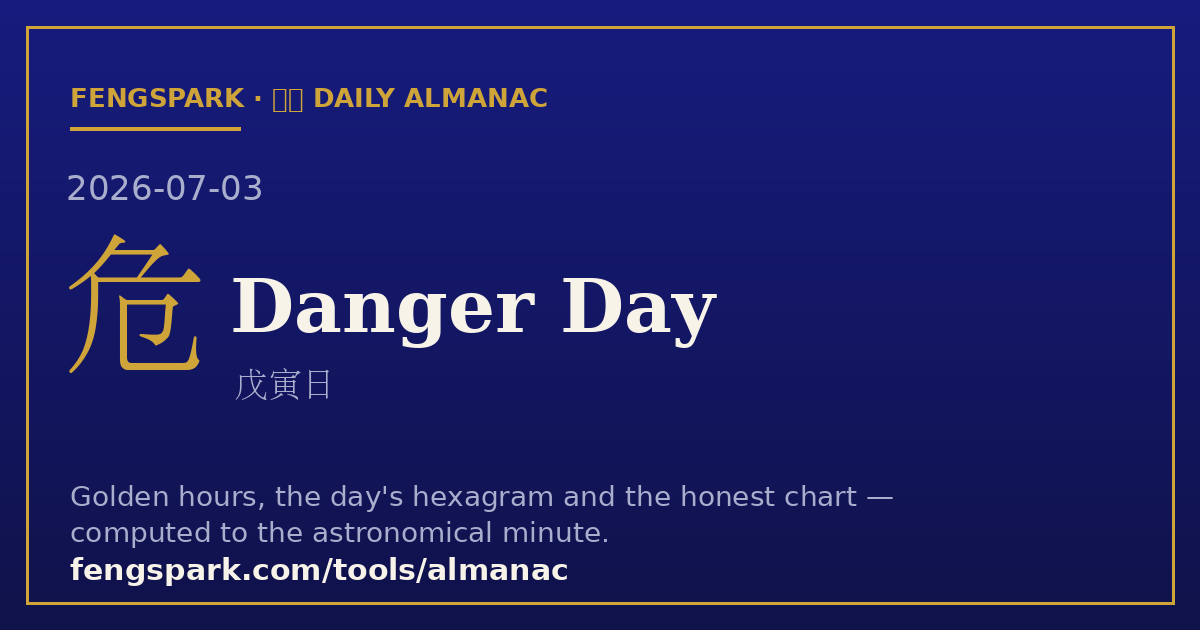
The day officers (建除十二神). The twelve officers — Establish, Remove, Full, Balance, Fix, Initiate, Break, Danger, Success, Receive, Open, Close — rotate with the day branches, but the cycle re-anchors at each solar term. Get the term boundary wrong by rounding, and every officer after it drifts. A "Success day" that is actually a "Break day" is not a small error; in the classical logic it is the opposite advice.
The pillars (干支). Day and hour pillars are functions of true astronomical time. The hour pillars in particular divide the day into twelve double-hours whose quality shifts with the day stem — the same 卯時 (5–7 am) that is golden today may be ordinary tomorrow.
Why the minute matters energetically
The tradition's own explanation is coherence: a moment's quality is the alignment of cycles — solar, sexagenary, directional — and alignment is by definition a matter of precision. Psychologically, the practical effect is just as real: a person who acts inside a window they trust acts with commitment, and commitment compounds. Vague timing produces vague action. The texts insist on the instant because the human using them needs an instant, not a mood.
What FengSpark does differently
FengSpark computes rather than approximates. The solar-term instants in our engine are astronomical events, calculated to the minute — no lookup tables that quietly say "on or around the 21st." The day officer, the golden hours, the hexagram of the day, the Qi Men charts behind them: all of it is derived from those instants, and on a boundary day the almanac tells you the exact minute the day changes character.
That is also why our Day Almanac can print a sentence most apps cannot: "Hour charts change at 16:20 today." Not because it sounds impressive — because the classics require it, and because you may be signing something at 16:05.
Use it
The Day Almanac is free, computed fresh every day, and shows the officer, the golden hours and the day's hexagram in one view. When the date matters — a launch, a registration, a first meeting — check the boundary line before you check your watch.
Ancient rules, kept honestly, turn out to be an engineering specification. We simply implemented it.